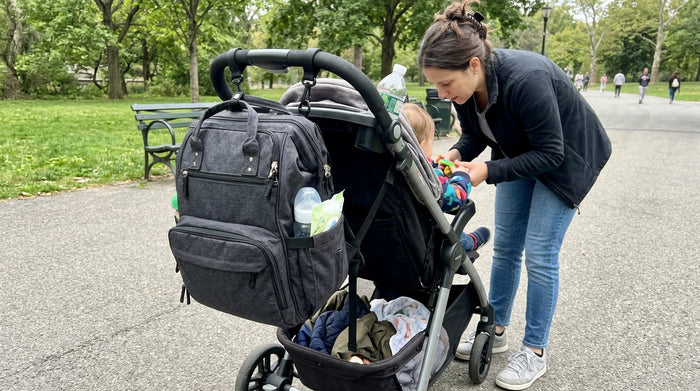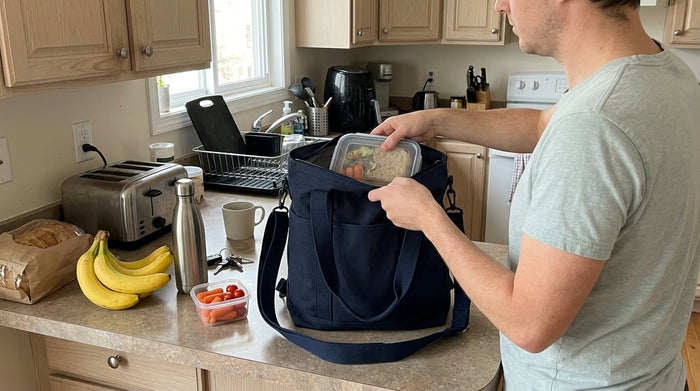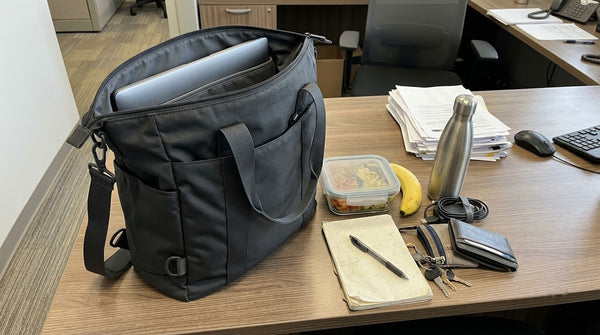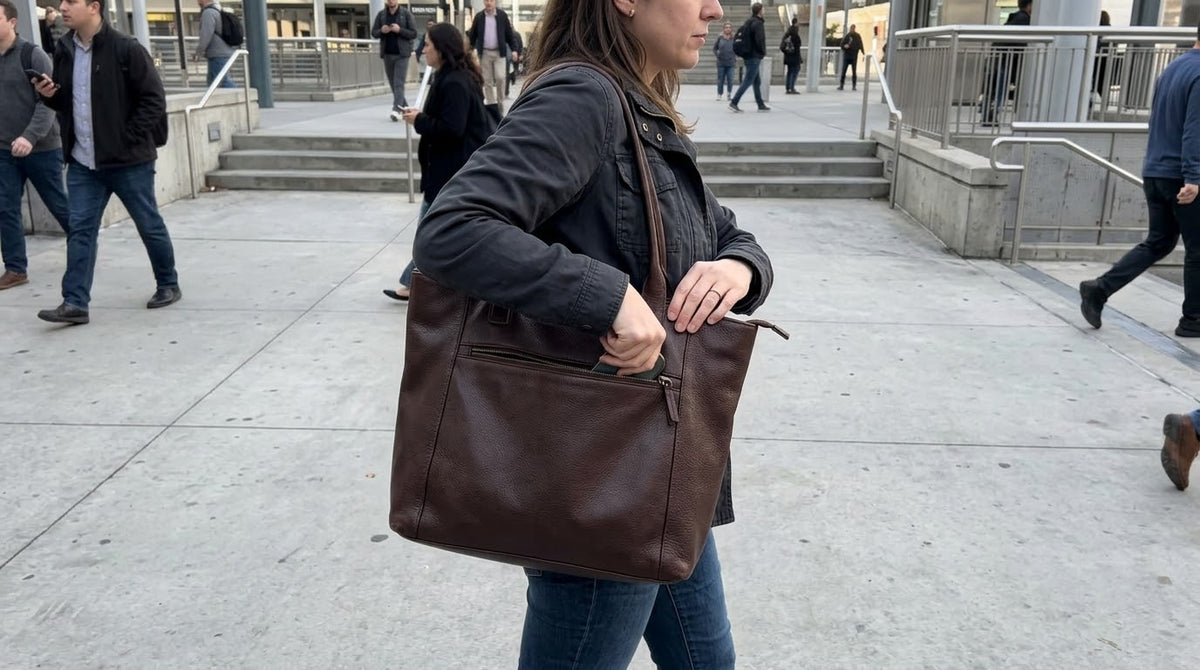
Facing the front pocket out puts your phone, keys, and cards within easy reach. Facing it in keeps them tucked away and harder to grab. The better choice depends on what you reach for most during the day.
What "front pocket out" and "front pocket in" mean
Most tote bags have two sides, a front and a back. If the front has a pocket, you can carry the bag with that pocket facing away from your body or against your body. That choice sounds small, but it decides which side of the bag other people see and which side you can touch without looking.
This page is a guide to finding your way through that choice. It is not a rulebook. Here is how it is laid out:
- Pocket out: what you gain in speed and what you give up.
- Pocket in: what you gain in comfort and calm.
- The habit question: what we can say honestly about how this changes the way you use a bag.
- A checklist: what to look for on any tote's product page.
- A one-week test: a way to decide for yourself.
Find your situation fast
If you are short on time, match your day to one of these lines and then read the matching section.
- You grab your phone or transit card many times a day. Read the "pocket out" section.
- You walk through crowds, trains, or busy markets. Read the "pocket in" section.
- You carry a laptop and lunch to work. Read the checklist and the product section near the end.
- You are not sure and want to decide by trying. Jump to the one-week test.
Front pocket facing out: what changes in your day
An outside pocket lets you reach an item without opening the main part of the bag. One bag-design article says an exterior pocket suits things you take out often, because you do not have to open the main compartment to get them (source). When the pocket faces away from your body, your hand can find it more easily, especially if the bag hangs at your side.
Another bag listing describes a dedicated quick-access phone pocket as a way to keep a frequently used item within reach (source). The idea is the same. The things you need most should be the easiest to touch.
What you give up is some privacy. A pocket that faces outward is visible and reachable by other people as well as by you. If the pocket has a zip or a closing flap, this matters less. If it is open at the top, you may want to keep only low-risk items there, such as a tissue pack or a pen.
Good things to keep in an outward-facing pocket:
- A transit card or badge you tap many times a day
- Lip balm, tissues, or a small pen
- A phone, if the pocket closes and fits it snugly
Front pocket facing in: what changes in your day
When the pocket sits against your body, you trade speed for calm. You can still reach it, but you may need to shift the bag or use your other hand. That small pause can be a good thing in places where you do not want to pull out valuables quickly or where the bag is pressed against you.
The same bag-design article notes that items in an interior pocket are less likely to fall out of the bag if they slip out of that pocket (source). That point is about inside pockets, not about turning the bag around. Still, it shows the general rule. The closer an item is to your body and the inside of the bag, the less exposed it is.
Good things to keep in an inward-facing pocket:
- Cash or a spare card you rarely need
- House keys you only use at the start and end of the day
- Small items you do not want to show, such as medicine or headphones
Does the direction really change your habits?
It is fair to ask, and the honest answer is that nobody has proven it. The sources reviewed for this guide describe practical differences in access and storage. They do not show that facing the front panel inward or outward changes people's habits in any measured way.
What we can say is what is simple and sensible:
- If an item is easy to reach, you will probably reach for it more often.
- If an item is hard to reach, you may leave it in the bag until you really need it.
- If a pocket is hidden, you may feel calmer in a crowd, but you may also forget what you put there.
These are everyday observations, not study results. Treat them as a starting point and test them in your own routine.
Carry style matters as much as pocket direction
How you carry a tote can change which side faces out in the first place. A tote on your shoulder, a bag in your hand, and a bag worn across the body all place the front panel differently. One retailer listing for a different bag says it converts between backpack, crossbody, and tote styles (source). If a bag can be carried several ways, check how the pocket sits in each one.
A simple way to think about it:
- Hand-held or shoulder: the front panel usually faces away from you, so an outside pocket is easy to see and reach.
- Across the body: the bag sits at your side or hip, so you can choose which panel touches you.
- On your back: the front panel usually faces away from you, and you will not be able to reach it yourself without taking the bag off.
A checklist for any tote's product page
When you look at a tote online or in a shop, these are the things worth finding before you decide. Most good product pages answer them in the description or the photos.
- Is there a front pocket at all? Look at the photos from the front, not only from above.
- Does the pocket close? A zip, flap, or magnet makes outward-facing use safer.
- How many inside pockets are there? More inside pockets mean you can keep valuables away from the outside.
- What size is the bag? A deep, wide tote can make a small front pocket feel far away.
- How heavy is it empty? A lighter bag is easier to turn, swing, and adjust through the day.
- What are the main closures? A zip on the main opening protects what you carry, whichever way the front faces.
Where the 3-in-1 Totebag fits
If you want a tote that gives you several inside spaces, the 3-IN-1 Totebag is worth a look. It costs $69. The product description lists an anti-theft zipper and seven interior pockets, which gives you room