Facing the front panel out puts your pocket in easy reach. Facing it in keeps your things closer to your body and out of sight. Nothing proves that either way changes your habits on its own, but each one changes how fast you can grab things and how safe they feel.
What "front panel out" and "front panel in" mean
Most totes have a front and a back. The front often has a pocket, a zipper, a logo, or a little detail that makes it look finished. When you carry the bag, one side faces the world and the other side rests against your body.
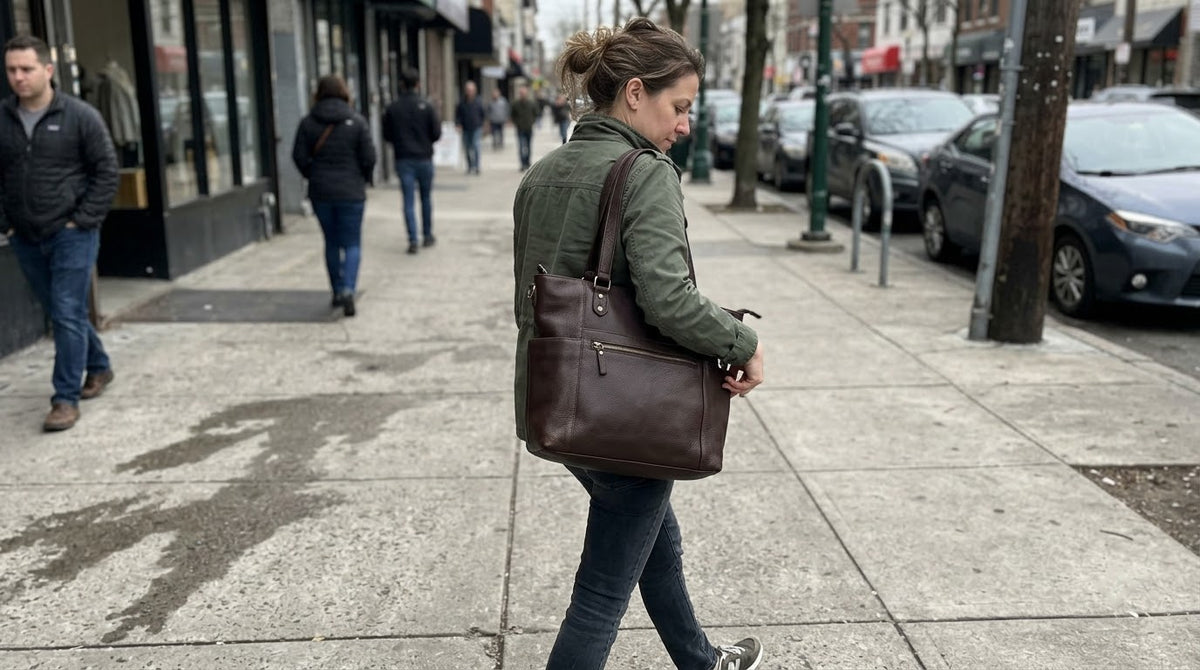
Front panel out means the pocket side faces away from you. Anyone walking behind or beside you can see it, and so can you if you look down.
Front panel in means the pocket side presses against your body. The plain back of the bag faces outward.
It sounds like a small thing, and it is. But a small choice you make hundreds of times a month can add up to a lot of tiny moments of ease or annoyance. That is why it is worth thinking about before you buy your next bag.
Why the facing side matters in real life
A bag is not just a container. It is something you open, reach into, set down, and pick up all day. Every one of those moments is shaped by where the pockets are and which way they point.
Here is the honest starting point. The research we looked at does not show that turning the front panel in or out changes people's habits. What it does support are practical differences in how easy things are to reach and how well they stay put. So the sensible way to decide is to ask what you grab most often and where you want it to be.
- Things you grab all day: phone, keys, transit card, lip balm.
- Things you touch once or twice: a laptop, a notebook, a lunch box.
- Things you want to keep safe: wallet, passport, medicine, spare cash.
Each group wants a different spot. The bag side you choose decides which group is easiest to get to.
Front panel out: best for quick grabs
When the pocket side faces out, the pocket is on the outside of the bag. An exterior pocket is useful for items you take out often, because you can reach them without opening the main compartment, according to a bag-design article.
Think about the small things you reach for on a normal day:
- Your phone when it buzzes on the train.
- Your transit card at the gate.
- Your keys at the door.
- A tissue or a pen when you are in a hurry.
With the front panel out, you do not need to dig. You find the pocket, grab the item, and move on. Some convertible bags even include a dedicated quick-access phone pocket so a frequently used item stays within reach, as one product page describes.
Who this suits:
- People who check their phone often.
- Commuters who tap in and out all day.
- Parents and teachers who need small items fast.
- Anyone who hates opening the whole bag for one small thing.
The trade-off: anything in an outside pocket is more exposed. In a crowd, you may feel less relaxed about it. Many people keep a quick-grab item there and keep valuables deeper inside.
Front panel in: best for a calm, close feel
When the pocket side faces in, it sits against your body. Your hand does not need to reach out to the world to get to it. This can feel more private. Passers-by cannot easily see the pocket, and nobody can casually reach into it without you noticing. That is common sense, not a lab result, so treat it as a comfort tip and not a guarantee.
Interior storage also helps with spills. Items stored in an interior pocket are less likely to fall outside the bag if they slip out of that pocket, a bag-design article notes. So if you carry small things you cannot afford to lose, such as earbuds, a ring, or a spare key, a pocket on the inside is a calmer home for them.
Who this suits:
- People who walk through busy streets or crowded stations.
- Travelers who want valuables close.
- Anyone who likes a clean, simple look from the outside.
- People who open their bag once, put things away, and leave it alone.
The trade-off: a pocket against your body is slower to reach. You may need to turn the bag, shift it, or pull it forward. If you grab your phone twenty times a day, that adds up.
A simple way to think about it
Ask one question: how often do I reach for the thing in that pocket?
- More than five times a day: front panel out is usually easier.
- Once or twice a day: either way works.
- Almost never, but it matters a lot: front panel in feels safer.
This is not a rule from a study. It is just a practical way to match the bag to how you live.
How your day changes the answer
The same person may want both options in the same week. Here is how it often plays out.
On a work commute. You tap a card, check messages, and grab a coffee. Front panel out makes these small moves smoother, and you are not stopping to open a bag in a crowd.
On a busy weekend street. You are shopping, walking slowly, and surrounded by people. Front panel in can feel calmer because your pocket is tucked against you.
On a school or hospital shift. You may need a pen, a badge, or a snack, fast. Front panel out keeps those within a quick grab, while your lunch and laptop stay safe inside.
On a trip. You switch between airports, taxis, and cafés. Many travelers like to have their passport tucked close and their phone handy, which means using both sides for different items.
Why flexibility beats a fixed choice
Since your day changes, a bag that lets you change how you carry it is a real advantage. A 3-in-1 style bag is built around that idea. For example, one product description says its bag converts between backpack, crossbody, and tote styles, which suits different daily situations.
The point is not that one carry style is magic. The point is that you should not be stuck with a single way of holding your things when your day has three or four different moods.
Meet the bag that makes this easy
If you want a tote that works for both habits, the 3-IN-1 Totebag is built for a full day. It is $69, and here is what it gives you, based on the product details:
- Anti-theft zipper to help keep the main space closed and your things in place.
- 7 interior pockets so small items have a home and do not sink to the bottom.
- A 100% leak-proof food compartment for lunch without the worry.
- Waterproof exterior and an easy-to-clean inside lining for messy days.
- Premium le
Keep reading