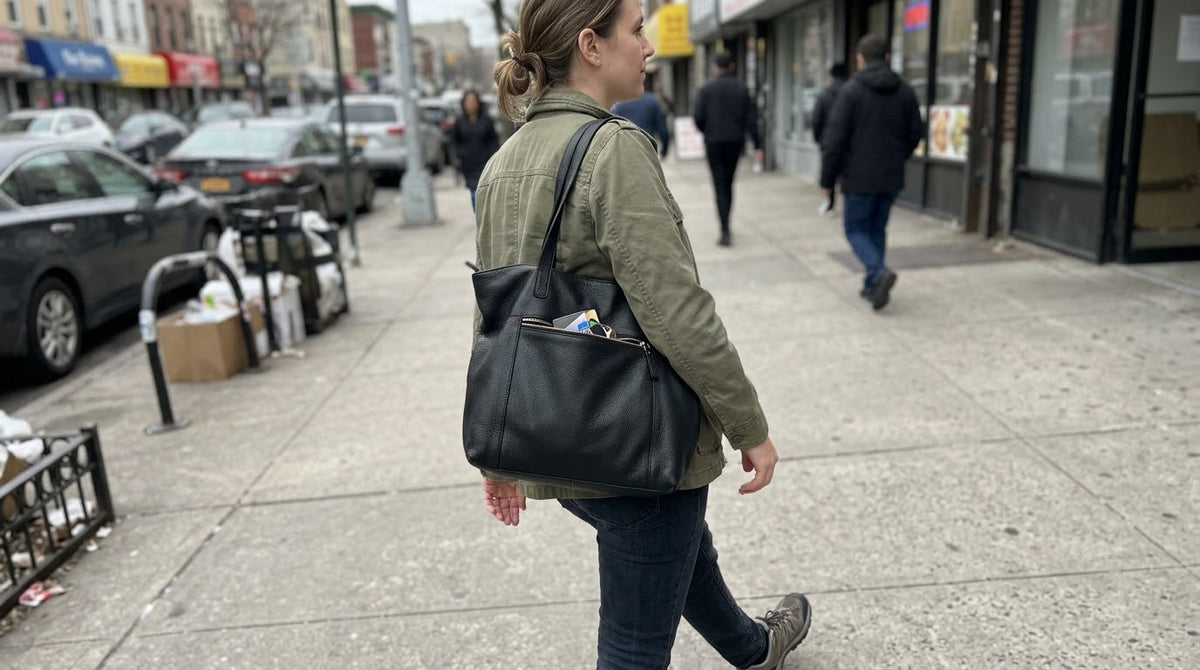
If the front of your tote faces out, its outside pocket is easy to reach. If it faces in, that side stays close to your body, which feels safer but is slower to use. No study proves this changes your habits, but it does change what feels easy to do.
What do "front facing out" and "front facing in" mean?
Most totes have a front side and a back side. The front is usually the side with the outside pocket, the logo, or the nicest finish. When you carry the bag on your shoulder or in your hand, one side rests against your body and the other side faces the world.
"Front facing out" means the front side points away from you. People walking past see it, and you can see the outside pocket only if you look down and over. "Front facing in" means the front side rests against your body, so the back side shows to everyone else.
It sounds like a tiny thing. But a bag is something you touch dozens of times a day, and a small change in where the pockets sit can change how often you open the main part, where you keep your phone, and how safe you feel on a busy street.
Why the direction matters at all
The biggest reason is reach. A pocket on the outside of a bag lets you grab something you need often without opening the main compartment, as one bag-design article explains. Think of a transit card, keys, or lip balm.
Some bags are built around that idea. One convertible bag, for example, has a dedicated quick-access phone pocket so a thing you use all day stays within reach. When you turn the bag so that pocket faces outward, it is easier to get to. When you turn it inward, the pocket is tucked against you.
So the direction is not a style rule. It decides which pockets you can reach fast and which ones are hidden behind your arm or hip.
What changes when the front faces out
With the front outward, the outside pocket is on the side your free hand can reach most easily. That tends to make quick grabs simple. Here is what that looks like in daily life:
- Quick grabs are easier. Your phone, card, or keys are a short reach away, so you may not need to open the bag at all.
- The bag shows off its front. If you like the look of the front panel, this is the way people will see it.
- Things on the outside are more exposed. In a crowd, a pocket facing the street is also easier for other people to touch or bump.
- The outside gets more wear. Rubbing against doorframes, car seats, and railings happens on the outward side.
This is a good fit for short trips, errands, and days when you tap your phone or card a lot. It is less ideal on a packed train or in a busy market where you want valuables close.
What changes when the front faces in
With the front facing your body, the outside pocket is pressed against you. It is harder for anyone else to reach, and it is also harder for you. Here is what you might notice:
- The pocket feels more private. Whatever you keep there sits between the bag and your body.
- Quick access is slower. You may need to swing the bag around or open the main part to get what you need. The available sources describe quick-access pockets but do not directly compare the two directions, so this is common sense, not a tested result.
- The front panel stays cleaner. It rubs on your clothes instead of the world.
- The back panel becomes the "face" of the bag. If it is plain, the bag will look plainer.
This works well when you are walking in a crowd, traveling, or carrying things you would hate to lose. It trades speed for peace of mind.
Pockets inside vs. pockets outside: where do spills go?
The direction of the front is only half of the story. The other half is whether your small items live in an inside pocket or an outside one. A bag-design article points out that items stored in an interior pocket are less likely to fall outside the bag if they spill from that pocket.
That gives you a simple way to sort your things:
- Outside pocket: things you grab many times a day and would not mind being easy to reach, like a transit card or a lip balm.
- Inside pocket: things that matter more or that you do not want falling out, like keys, earbuds, a spare charger, or small cash.
- Main compartment: bigger things you only need now and then, like a notebook, a lunch box, or a laptop.
Once your things are sorted this way, the direction of the front matters less for your valuables and more for your quick-grab items.
Does it really change your habits?
Here is the honest answer. The sources we looked at support practical differences in access and storage. They do not show that turning the front inward or outward changes people's habits in a measured, proven way.
That said, it is reasonable to think that anything that makes a task easier gets done more often. If your card is one reach away, you will probably reach for it more than if it is buried. If your phone is tucked away, you might check it less often while walking. These are likely effects, but treat them as ideas to test, not facts.
The best way to find out is to try it on your own bag for a few days and watch what you do. That is why the next sections are about noticing, not about rules.
Habits you might notice, and how to steer them
Try keeping an eye out for these patterns. None of them is guaranteed, but many people find some of them in their own day.
- How often you open the main part. If you keep quick items outside and the front faces out, you may open the main compartment less. If the front faces in, you may open it more.
- Where you put your phone. A phone in an easy outside pocket is easy to check. A phone tucked away may stay put longer.
- How much you glance at the bag. People often check a bag more in crowded places. If the pocket faces inward, you may check less because it feels safer.
- How tidy the bag stays. When every item has an inside or outside "home," you tend to put things back in the same spot.
- How you set the bag down. The side that touches the floor or a chair is usually the back. Facing the front out may keep the nicer side away from the ground when you sit down, but only if you set it that way on purpose.
If you want to use your quick pocket more, face it out. If you want to forget about it and feel calm, face it in. You can choose the habit you want.
Carrying a bag more than one way
Some bags can be carried in several ways, and that makes the direction question even more interesting. One retailer describes a bag that converts between backpack, crossbody, and tote styles. Each style puts a different side of the bag against your body.
When you change the way you carry, the "front" may change too. For example, a pocket that faces out when you hold a bag by the handles may end up against your back when you wear it as a backpack. So it is worth checking where your favorite pocket lands in each style, not just in your usual one.
A simple rule helps: put the pocket you use most on the side you can reach with one hand without taking the bag off. Then put anything you want to protect on the side or the inside that stays closest to you.
A simple one-week test
If you cannot decide, run a short test. You do not need any special tools.
- Days 1 to 3: Carry your tote with the front facing out. Keep your quick items in the outside pocket. Notice how often you reach for it and whether you feel uneasy anywhere.
- Days 4 to 6: Flip it so the front faces in. Move valuables to an inside pocket. Notice whether you miss the quick access.
- Day 7: Decide. Pick the direction that matched most of your week, and keep the other one for crowded places or travel days.
You may find that you want both. Many people end up with front-out for office and errands, and front-in for transit and trips.
Where the 3-in-1 Totebag fits in
If you like to be organized, a bag with plenty of pockets gives you more choices about what goes where. The 3-IN-1 Totebag