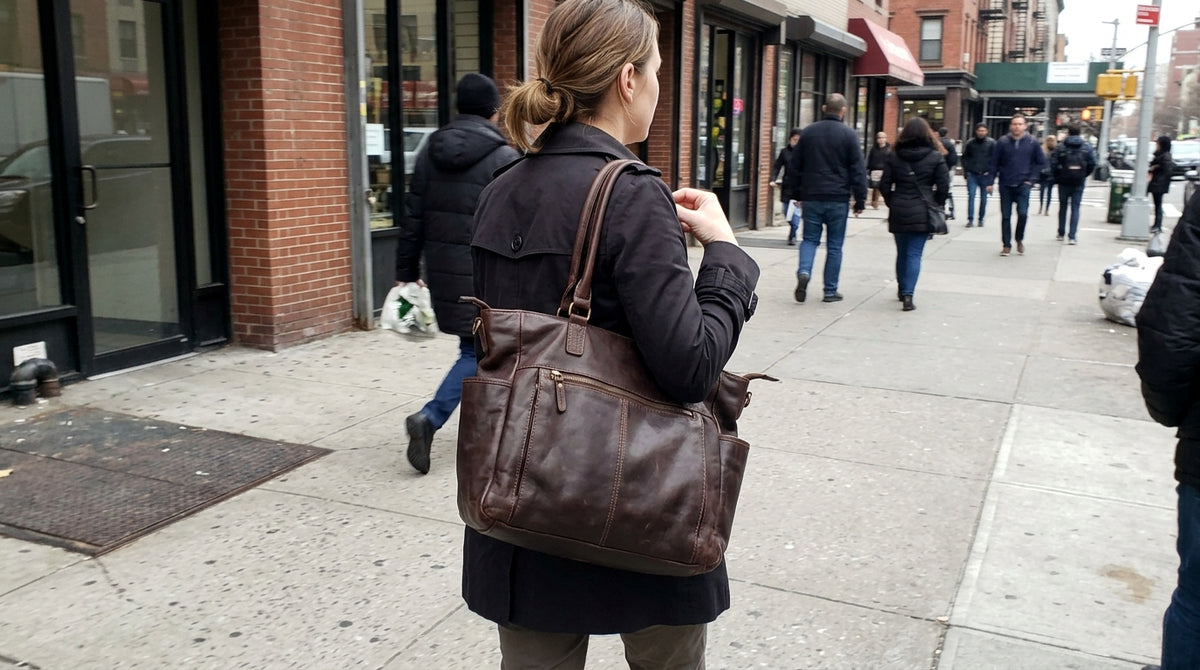
With the front facing out, you can reach pockets fast, but other people can reach them too. With the front facing in, your things feel more private, but you grab them more slowly. Pick the side based on what you reach for most often.
What "front facing out" and "front facing in" actually mean
Every bag has two big faces. When you carry it on your shoulder or at your side, one face is near your body and the other faces the street, the train, or the office hallway. The face with the pockets, the logo, or the main zipper is what most people call the front.
So the question is simple. Do you want that front side looking at the world, or tucked against you? It sounds like a tiny choice. But you make it dozens of times a week, and it quietly shapes how you use the bag.
Here is the honest part. I could not find solid proof that this choice changes people's habits in a big way. What I can tell you is how each side changes how fast you reach things and where your stuff sits. Habits grow out of those two things, so they are worth thinking about.
Front facing out: what you gain and what you give up
When the front faces out, anything on that side is in plain view and close to your hand. An exterior pocket is useful for things you take out often, because you can get to them without opening the main compartment. Think of your phone, your transit card, your keys, or lip balm.
That changes how you move through the day. You stop digging. You stop stopping. You grab the thing and keep walking.
Here is what usually follows:
- You check your phone more easily. It sits within reach, so you do not have to open the whole bag.
- You tap in and out faster. A card on the outside side means less fumbling at gates and counters.
- You may carry fewer loose things in your hands. Small items have a home you can reach in one move.
There is a trade-off. Anything on the outer side is also easier for someone else to reach, especially in a crowd. If you walk through busy trains, markets, or events, that matters. You may end up keeping only low-risk things out there and moving the important stuff deeper inside.
Front facing in: what you gain and what you give up
Turning the front toward your body does the opposite. Things feel more private because your arm and side cover them. If you ever wear the bag so the pockets press against you, you can feel them and know nothing is being touched.
That tends to change habits in a calmer way:
- You become more careful about what goes where. Valuables go in the pockets near your body, and everyday items go in the open space.
- You reach less often while moving. Getting to a pocket may mean pausing, turning the bag, or lifting it.
- You feel more relaxed in crowds. You are not guarding the bag as much.
The cost is speed. If you need your phone every few minutes, turning the bag around each time gets old. Many people who start this way end up switching, or they move the phone to a different spot.
Inside pockets change things too
The front and back are only part of the story. What sits inside matters as much. According to one bag-design article, items stored in an interior pocket are less likely to fall out of the bag if they spill from that pocket. That is a nice habit-builder. When you know small things stay inside, you stop worrying about them every time you set the bag down or lean forward.
So a good rule is to match the pocket to the job:
- Grab-and-go items (phone, transit card): easy-to-reach spot.
- Things you need once or twice a day (wallet, earbuds): a pocket you can reach without looking.
- Things you rarely touch (spare keys, medicine, a charger): a deeper pocket you do not need to open often.
What the research says, and what it does not
I want to be clear about this so you do not take a guess as a fact. The sources I looked at talk about quick-access pockets and storage, not about which way the front of the bag faces. For example, a convertible bag with a dedicated quick-access phone pocket is described as keeping a frequently used item within reach. That supports the idea that easy access changes how often and how quickly you use something.
None of these sources prove that turning the front in or out changes people's habits on its own. What they do support is plain and practical: where the pocket sits changes how easy the item is to reach, and where you store things changes how safe they feel. Everything else in this article is a sensible way to use that idea, not a study result.
If you like to test things, that is good news. You do not need a rule from an expert. You can just try both sides and see what feels right to you.
How this fits your 3-in-1 Totebag
You already have the 3-IN-1 Totebag, so let's use what it offers. The listing says it has an anti-theft zipper and seven interior pockets, plus a waterproof exterior, an easy-to-clean inside lining, and a leak-proof food compartment. It fits laptops up to 17 inches and weighs 1.1 lbs.
Here is how I would think about those features when you choose which side faces out:
- Seven interior pockets mean you have choices. Put your must-keep-safe items in the inside pockets, so the side facing out matters less for them.
- The anti-theft zipper is something to place on purpose. Look at where the zipper sits on your bag. If it is on the side that touches your body, you get extra peace of mind. If it faces out, keep only things you can afford to reach for in public in that spot.
- The waterproof exterior helps on messy days. If the outer face gets splashed or set down on a wet floor, it is built for that. This makes facing it out less of a worry on rainy commutes.
- The food compartment is best treated like its own zone. The listing describes it as leak-proof, so keep lunch and drinks in it and away from your laptop and papers. That way, you do not need to think about the bag's direction to keep your food and tech apart.
I will not claim to know exactly how every part of your bag is laid out, because that depends on the one in your hands. Open it up, look at where each pocket and zipper sits, and plan from there.
A simple one-week test
Instead of guessing, try this. It takes almost no effort.
- Days 1 to 3: front facing out. Notice how often you reach for your phone or card. Does it feel faster? Do you feel nervous in crowds?
- Days 4 to 6: front facing in. Notice how often you stop to get something. Do you feel calmer? Do you feel slowed down?
- Day 7: decide. Pick the side that gave you fewer annoyances, and keep it.
A few notes while you test. Keep a small list in your phone if that helps. Write down what you grabbed the most and where it lived. After three days, you will likely